













If you own an electric vehicle, nearly all of your charging happens in one place: at home, overnight, while you’re asleep. That’s the part that surprises people coming from gasoline. You don’t go somewhere to refuel — you plug in when you get home, and the vehicle is full when you leave. Public charging exists for trips.
So the real question isn’t “where will I charge?” It’s “what does it take to set up charging at the house?” In most Grande Prairie and Peace Country homes, the answer is a 240-volt circuit run to the garage by a licensed electrician. Here’s what that involves, and what winter does to the whole arrangement.
Level 1 versus Level 2
Level 1 is a standard 120-volt household outlet — the ones already in your garage. Every EV can charge from one, usually with a mobile cord that comes with the vehicle. There’s nothing to install and nothing to buy, which is genuinely useful. It’s also slow: Level 1 adds a modest amount of charge over a night, which is plenty for a short commute or for keeping a plug-in hybrid topped up, and not enough to refill a large battery that you’ve run down.
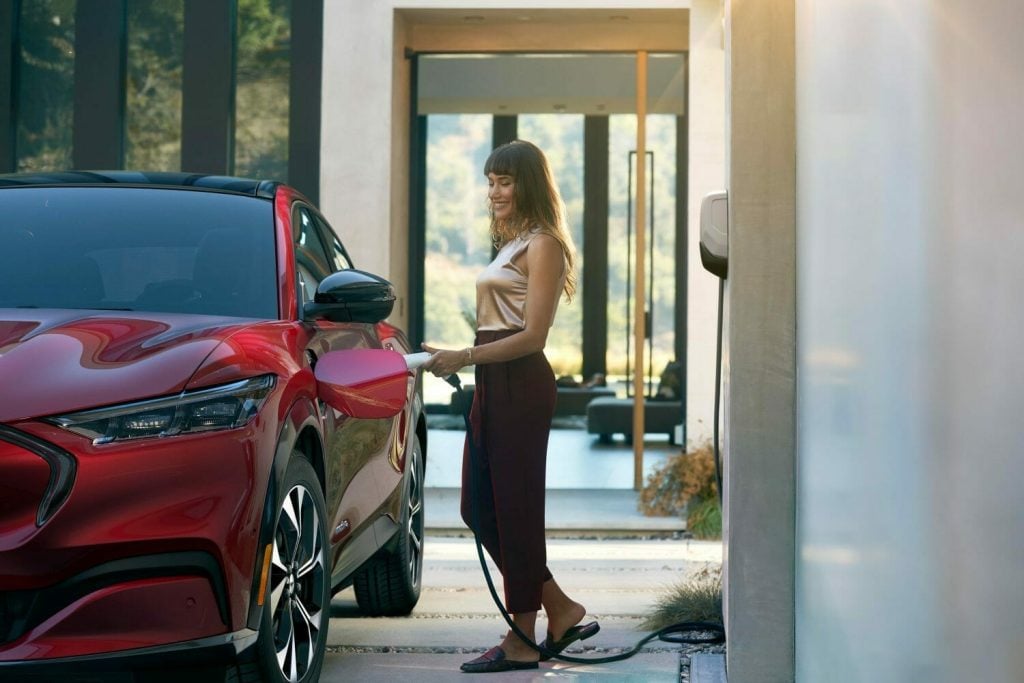
Level 2 is a 240-volt circuit — the same class of circuit that feeds an electric range, a dryer or a welder. It charges several times faster than a household outlet, which is the difference between “the car is full every morning” and “the car is catching up.” This is what the large majority of EV owners end up with, and it’s the setup that makes a battery-electric vehicle behave the way people hope it will.
DC fast charging is a third category, and it isn’t a home option. Fast chargers are commercial equipment running on far higher power than any house supplies. They’re the road-trip tool, covered further down.
Why home charging is the normal case
Two reasons. First, cost: charging at home on residential electricity is the cheapest energy your vehicle will ever take, and it’s cheaper than gasoline by a wide margin — that fuel-cost difference is usually the largest number in the ownership comparison. Second, time: nobody stands beside their car in a parking lot when the alternative is plugging in beside the deep freeze and going to bed.
The practical test for whether an EV suits you isn’t range. It’s this: do you park in the same place most nights, and can that place get a 240-volt circuit? If yes, an EV is easy. If you’re street-parking or in a building that won’t allow an install, it’s harder, and a hybrid may be the better answer — the EV and hybrid guide covers that fork.
What a Level 2 install actually involves
This is electrician work, not a weekend project. The pieces:
A load calculation on your panel. Your electrician works out whether the existing service can carry another large circuit alongside the furnace, water heater, range, dryer and everything else. Older homes with smaller services are the ones most likely to need an upgrade — and a service upgrade is the item that turns a modest job into a bigger one.
Breaker space. Even with enough capacity, the panel needs two adjacent slots free for a double-pole breaker. Full panels can sometimes be handled with tandem breakers or a sub-panel.
The cable run. Distance and route from the panel to where the vehicle parks drives a lot of the cost. A panel on the garage wall is a short, cheap run. A panel in a basement at the far end of the house, with a run through finished space or underground to a detached garage, is not.
Hardwired unit or receptacle. A wall-mounted charging station can be hardwired, or you can have a dedicated 240-volt receptacle installed and plug a portable unit into it. The receptacle route keeps the equipment portable and makes replacement simple; hardwiring is tidier and is sometimes required for higher-power units. Your electrician will have a preference — ask why.
Permit and inspection. New circuits require an electrical permit and an inspection in Alberta. A licensed contractor handles this as part of the job. Don’t skip it: an uninspected DIY circuit is an insurance problem waiting to happen, on top of a safety one.
Outdoor and cold-weather ratings. If the equipment lives outside or in an unheated detached garage, it needs to be rated for it. Confirm the temperature range of the unit you buy — this is Alberta, not a catalogue photo from Vancouver.
Costs vary far too much by house to quote a figure here. Get two or three quotes from local electricians, and make sure each one has actually looked at your panel rather than pricing over the phone.
Renters, condos and acreages
Renting. You need the landlord’s permission, and the install stays with the building. Some landlords are open to it if a tenant pays; many aren’t. Level 1 from an existing garage outlet is the fallback, and it’s workable for a short commute.
Condos and townhouses. This is a condo-board conversation about a shared electrical service and how the power gets metered to your unit. It can be done, and it takes time. Start the conversation before you buy the vehicle, not after.
Acreages and shops. Often the easiest case of all. A lot of rural properties already have 240-volt service in a shop or a heated garage — sometimes with a spare circuit already run. Have an electrician confirm what’s there and whether it’s suitable.
Charging in the cold
Cold does two things to charging, and both are worth planning around.
A cold battery charges more slowly. Batteries have a preferred temperature range, and when they’re well below it they can’t accept energy quickly. The vehicle protects itself by limiting the rate, and may spend time warming the battery before it will take full power. At home overnight this rarely matters — you’ve got all night. At a fast charger after a long, cold highway run, it can.
Heating comes from somewhere. In a gas vehicle, cabin heat is a by-product of the engine. In an EV, it’s a load, and in deep cold it’s a big one.
The habits that fix most of it:
- Leave it plugged in whenever it’s parked in winter. Plugged in, the vehicle can manage battery temperature using power from the wall instead of eating into its own charge.
- Precondition while plugged in. Set a departure time or start the cabin heat from the app while the cord is still connected. You leave with a warm, defrosted vehicle and a full battery — the heating came from the house.
- Park inside if you have the option. A garage that sits even slightly above outside temperature improves both charging speed and range.
- Keep the charge port clear. Snow and freezing rain around the port and the connector are a real nuisance. Brush it off before you plug in, and don’t force a frozen latch.
- Expect the cord to be stiff. Charging cables get rigid at −30 °C. Coil it loosely and give it a minute.
Public and DC fast charging for road trips
DC fast charging is what makes longer trips work. A fast charger delivers far more power than any home setup, and the practical way to use it is in short stops along the route rather than as a full refill.
Two behaviours to know about:
Charging slows as the battery fills. Fast charging is quickest when the battery is fairly low and tapers off as it approaches full. That’s why experienced EV drivers on a road trip make a couple of short stops rather than one long one — the last part of a charge takes disproportionately longer than the first.
Cold slows fast charging too. If the battery is cold when you arrive, expect a slower session. Many EVs will precondition the battery automatically when you navigate to a fast charger, which is a good reason to route through the vehicle’s own navigation rather than your phone.
For the Peace Country specifically: the fast-charging network up here is thinner than it is around the larger centres, so plan a long trip around where the chargers actually are, check them in a charging app before you leave, and give yourself margin in winter. For everyday driving in and around Grande Prairie, none of this comes up — you’re charging at home.
What to sort out before you buy
- Where will the vehicle park most nights? Answer that first; everything else follows.
- What does your panel look like? A photo of the panel with the door open is enough for an electrician to give you a first read.
- What equipment comes with the vehicle? A mobile charge cord is often included, and what’s in the box changes what you need to buy.
- What connector does it use? Confirm the vehicle’s charge port and what adapters, if any, it needs for the public networks you’d use.
- Get the electrician’s quote before you finalize the budget. A straightforward install and one that needs a service upgrade are different numbers, and it’s better to know which you’re facing.
Where to go from here
Home charging is the whole ballgame for an EV, and for most Peace Country homes it’s a manageable electrician visit rather than a project. Sort that out and the vehicle takes care of itself.
Read the EV and hybrid hub for how battery-electric and hybrid ownership differ, browse the Mustang Mach-E, or contact us — tell us where you park and how far you drive, and we’ll tell you honestly whether an EV or a hybrid is the better fit.